Why Everyone Should Know How to Track Their Cycle
As is the case for many of us, I didn’t have a good SexED class. The extent of what I remember from our gym teacher was that our periods happened monthly, and if we had sex then we would get an STI (insert graphic pictures here) and die.
So naturally I thought everyone experienced their periods in the same way. It was only when I started talking to my friends that I noticed how erratic my periods were. While my friends were able to predict when their period would start like clockwork, mine was always a mystery.
I would get anxious whenever my periods would go “missing” even though I wasn’t even sexually active, “but what if”.
I started to keep track of my periods through apps. But they would never start when the app predicted they would. After a few years, I went on different hormonal birth controls that made me spot for months at a time until eventually my periods stopped altogether. It wasn’t until I was struggling with severe hormonal acne that I decided to stop using hormonal birth control, and my periods slowly returned. They were now more erratic than ever. With my periods being 2–3 months apart.
To be honest I thought it was strange, but my full focus was on getting rid of my hormonal acne. It was all I could think about and look into. That’s how I learned about hormone health and later on cycle tracking.
Being able to track my cycle and understand why they were long and how to shorten them has been nothing less than amazing. Having that knowledge, which should have been a part of my education growing up is why I teach cycle tracking now. Cycle tracking itself is a really broad term so let’s go over what exactly it is.
What is cycle tracking?
Cycle tracking is more of an umbrella term with everything from cycle tracking apps to using colored beads (called cycle beads). The main idea is to track your full cycle, not just the part that we see, our period.
Why do it?
Besides tracking the length of our cycle, we can also track things like pain level, breast tenderness, bloating, headaches, energy levels, etc. All of these are influenced by our 2 main hormones, estrogen and progesterone. By keeping track of these, we can find patterns that give us insights into our health. For instance, if you know that you get headaches before your period you can minimize planning big events around that time. While focusing on ways to manage or lessen the frequency of those headaches (Dandelion root tea is a great place to start).
It can also give you insight into your overall hormonal health. Keeping track of how long you are in your estrogen (follicular) phase vs your progesterone (luteal) phase. These hormones have a balancing act that impacts every cell in our body. From our bones and cardiovascular to mental health. So having a good balance between both is foundational to not only our cycle health but our well being as well. That’s why our cycle is seen as our fifth vital sign.
How do you track your cycle?
Tracking your cycle can be as simple or complex as you want it to be. I will say that the more detailed approach gives you A LOT more information about your hormonal health. Especially when you are prone to hormone imbalances like I am.
Simple:
A simple cycle tracking practice can be tracking things you notice. Your period length, bleeding amount, and pain levels, while also tracking things along the cycle. Like anxiety levels, headaches, sex drive, energy levels, hours of sleep, etc. Then at the end of the cycle, see how long the full cycle was. This lets you start to see some patterns.
Detailed:
Detailed cycle tracking has a professional method known as the Fertility Awareness Method. Under the umbrella term of cycle tracking, these methods are the ones that have a scientific basis. Specifically, the symptothermal method of tracking. The basis is that we track 2 biomarkers in our cycle. Our basal body temperature and our cervical fluid.
Basal Body temperature
Our basal body temperature is our at rest temperature, specifically in the morning. Estrogen and progesterone impact our metabolism. Which is why our temperature changes depending on where we are in our cycle.
Pre ovulation being our follicular phase, while post ovulation being our luteal phase
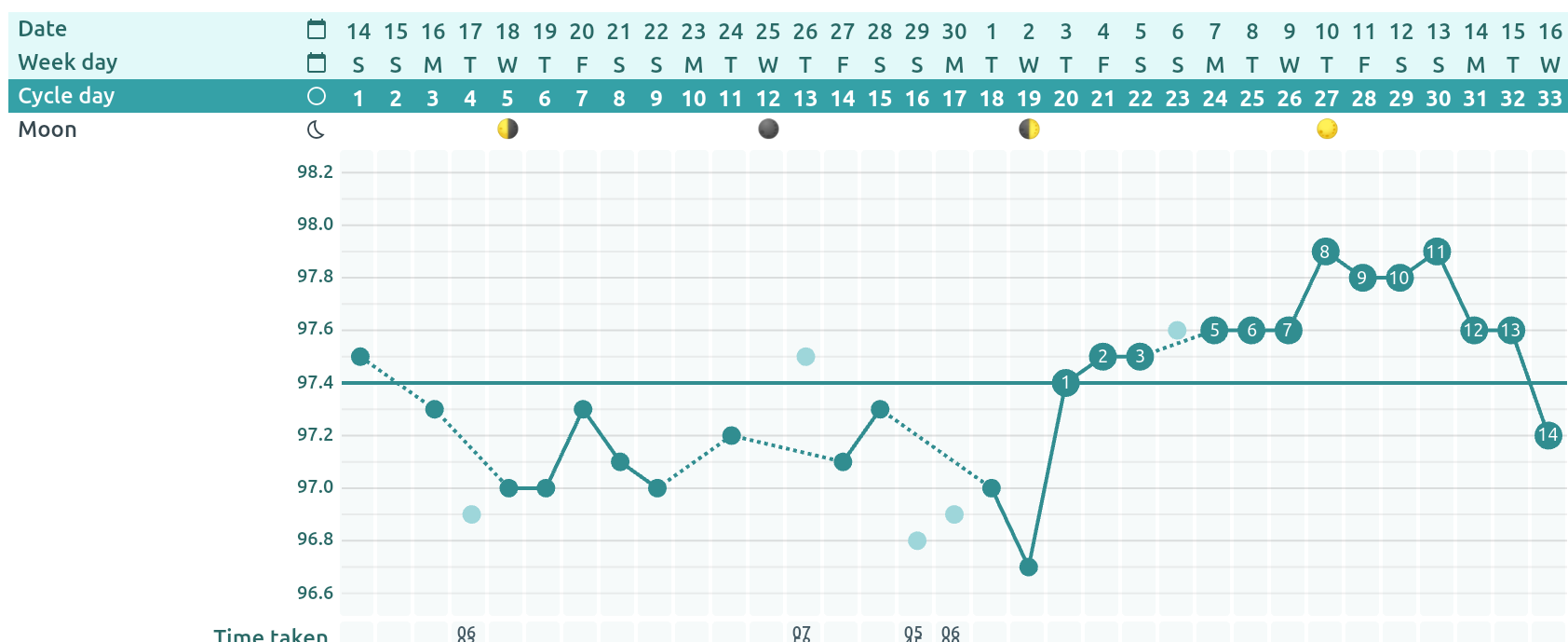
By taking our temperature every morning, we get to see how long these phases are. We also get insights into how stable our progesterone levels are. Ideally we want our temperature to be within a similar range in the luteal phase after it rises.
Cervical Fluid
As the name suggests, cervical fluid is fluid that comes from the cervix. It is directly impacted by estrogen, making it a cyclical occurrence.
Let me say that again, cervical fluid is impacted by estrogen, which means we experience it every cycle in the follicular phase.
Many people experience it if you’ve ever felt a rush and think you started your period early. Only to check and see nothing is there. Or you might think it’s sweat or an infection. But no, it’s a part of our cycle.
And yet we aren’t taught about it!?
Putting my anger in a box for now. Since cervical fluid is directly linked to estrogen, we can use it to track our follicular phase. As well as see how long we are producing estrogen. This is really helpful for those that lean more towards estrogen dominance.
Using both of these biomarkers lets you cross reference the information.
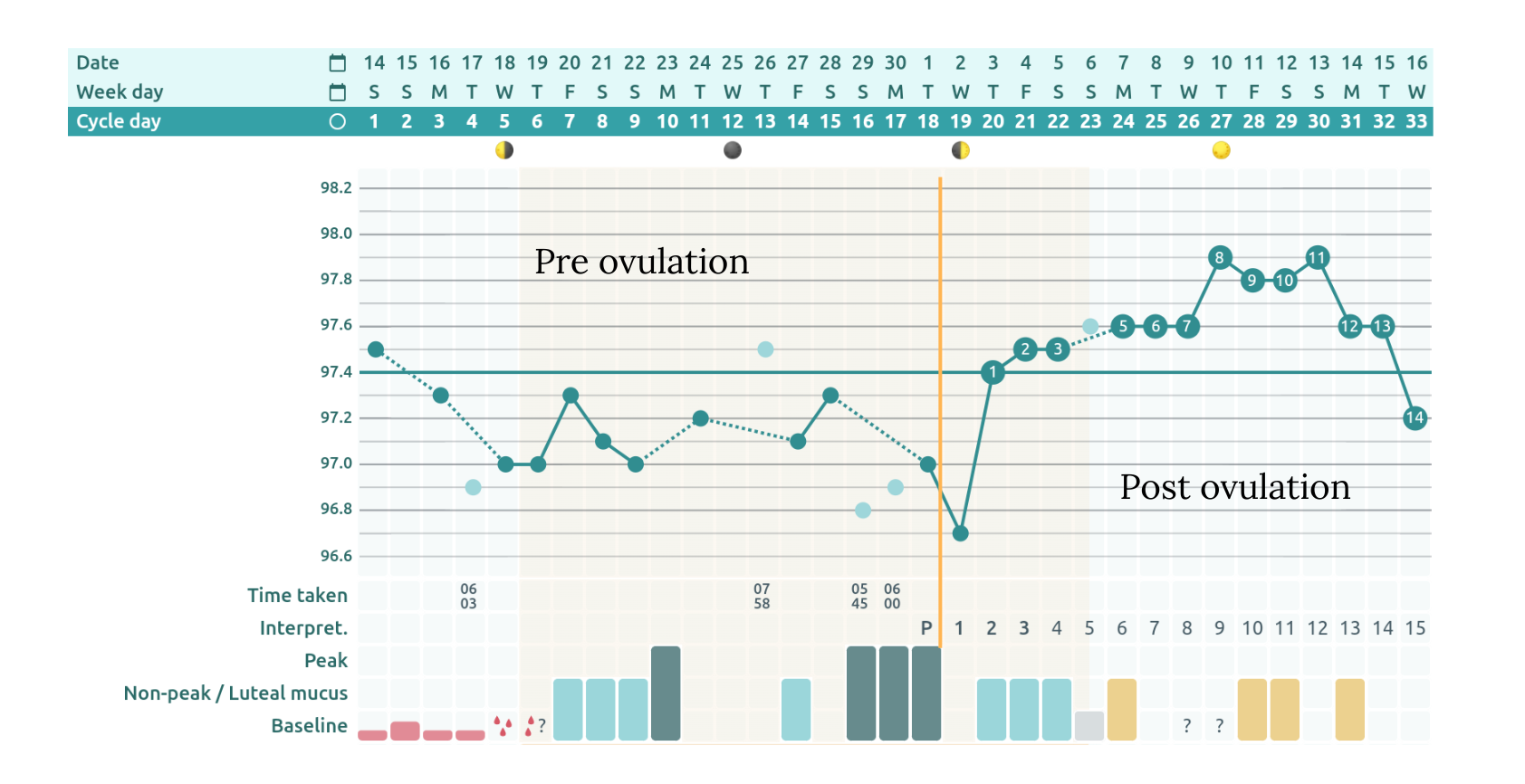
As you get closer to ovulation, you tend to see more cervical fluid because of the impact of estrogen. (The cervical fluid is marked by the colored bars at the bottom).
We’re in a time when medical gaslighting is still common. Research in hormonal health is still limited and way underfunded (not to mention when it is researched, the focus is on estrogen when that’s only half of the cycle). We still have a lot more questions than we do have answers. The best way I’ve found to get more information on MY own cycle is through charting. Not relying on a new biohack or supplement to solve all my problems when I myself don’t know what the question even is.
Check out this YouTube video where I talk about how I track my cycle to spot hormone imbalances.
Thank you for reading, and feel free to ask any questions